Uncertainty in markov chains: fun with snakes and ladders

I love board games. Over the holidays, I came across this interesting post over at Arthur Charpentier’s Freakonometrics blog about the classic game of snakes and ladders. The post is a nice little demonstration of how the game can be formulated completely as a Markov chain, and can be analysed simply using the mathematics of state transitions.

The particular board which was analysed had the following ‘portals’:

 starting=c(4,9,17,20,28,40,51,54,62,64,63,71,93,95,99)
 ending=c(14,31,7,38,84,59,67,34,19,60,81,91,73,75,78)

Given that a player roles a six sided die to determine how many positions forward to travel, the transition matrix can be defined as:


n=100
 M=matrix(0,n+1,n+1+6) ## from n+1 starting positions (0-100 inclusive) to n+1+6 ending (includes overshooting the last position)
 rownames(M)=0:n
 colnames(M)=0:(n+6)

for(i in 1:6){diag(M[,(i+1):(i+1+n)])=1/6} ##dice role probs from each position on the board

M[,n+1]=apply(M[,(n+1):(n+1+6)],1,sum) ##collect all of the 'overshooting' the ending probabilities
 M=M[,1:(n+1)]

for(i in 1:length(starting))
 {
 v=M[,starting[i]+1]
 ind=which(v>0)
 M[ind,starting[i]+1]=0
 M[ind,ending[i]+1]=M[ind,ending[i]+1]+v[ind]
 }

In order to calculate the probability distribution of a player’s position after h rolls, the initial position vector (what state is currently occupied) is multiplied by the transition matrix raised to the hth power.

 ### Multiply the transition matrix to get the position distribution ###
powermat<-function(P,h){
Ph<-P
if(h>1)
{
for(k in 2:h)
{
Ph<-Ph%*%P
}
}
return(Ph)
}
### -- ###

initial<-c(1,rep(0,n))
initial%*%powermat(M,h=1)

You can vary h and get the probability distribution of where a player will be on the board after that many rolls. Neat!

The thing is, this got me wondering… For the first roll, a player can end up in 1 of 6 possible positions (for this board 1,2,3,14,5 or 6), each with a 1/6 chance. We therefore can predict the position of a player after one roll with a good degree of confidence. If we wanted to predict the player’s position at roll 3, however, there are more positions which are possible (though not equally likely). So we would probably be less confident when trying to predict the position of a player after 3 rolls, and we would feel less and less confident the further out we get.

However, the game does end (although unfortunately for those who would like to move on to video games, this is not guaranteed – I leave it to the reader to prove this) and therefore we might expect to be fairly confident in predicting a player’s position after 100 rolls (they are probably at the finish line, of course). Which begs the question, how many rolls into a game would you be the least confident in predicting a player’s position?

To answer this question, we need a measure of uncertainty which can quantify how well we could predict a player’s position. It turns out, that the Shannon entropy measure does just that! The formula is very simple:

H=-∑p log(p)

entropy<-function(p){
ind<-which(p>0)
return(-sum(p[ind]*log(p[ind])))
}

The Shannon entropy defines how much information is missing about the outcome of a random variable. So, if there is no information missing, we know the outcome with p=1, and the Shannon entropy = 0. If a random variable can have n possible outcomes, then the Shannon entropy is at a maximum when p=1/n for each.

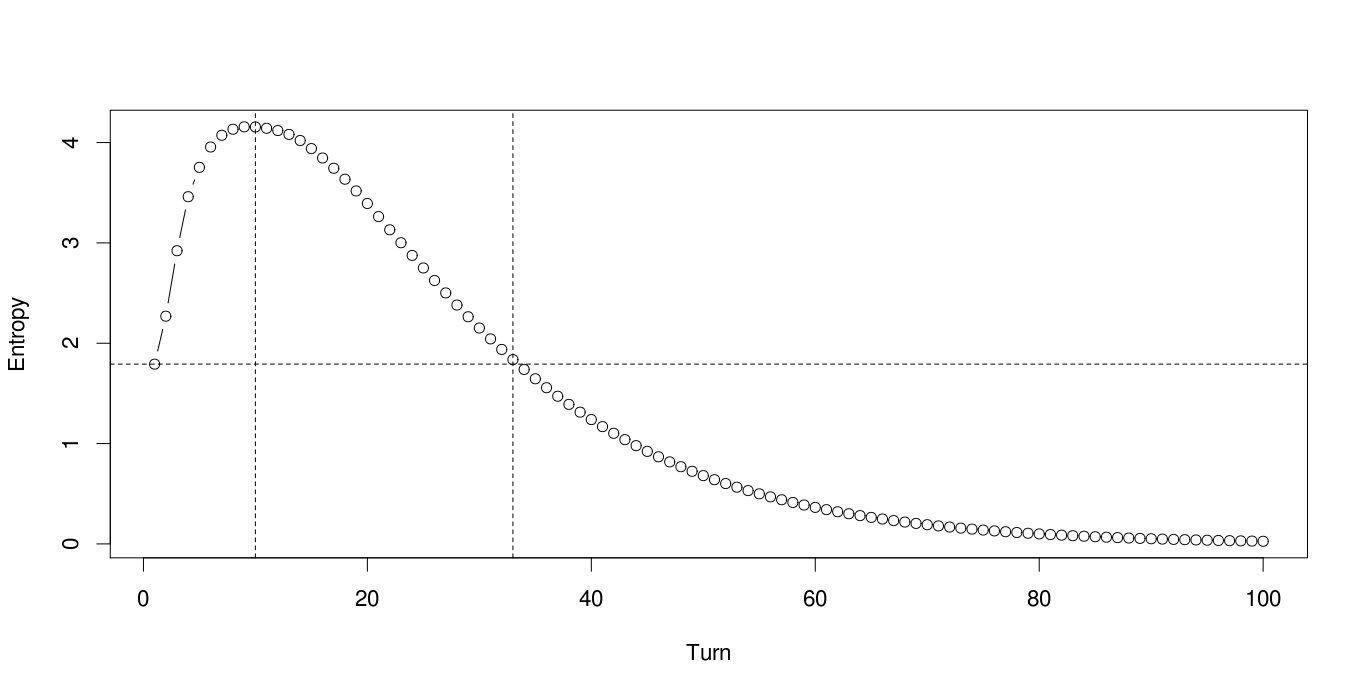
So, back to my question: how many rolls into a game is our uncertainty about a player’s position on the board at a maximum? Keep in mind that we are talking about uncertainty with respect to our predictions before the game is started. Any knowledge of a player’s position at any point in the game would of course change our predictions and associated uncertainty. To answer this question, we just need to calculate the Shannon entropy of the outcome distribution generated by our Markov chain, and find at which point it is maximised.

##############################################################
############ Calculate the entropy after n turns #############
entropy<-function(p)
{
ind<-which(p>0)
return(-sum(p[ind]*log(p[ind])))
}

turns<-100
ent<-numeric(turns)
for(n in 1:turns)
ent[n]<-entropy(initial%*%powermat(M,n))

plot(ent,type='b',xlab='Turn',ylab='Entropy')

Which is at a maximum (highest uncertainty) at roll 10. We are most certain of a player’s position at roll 1 as we might expect, but again from rolls 33 and on. After which, we become increasingly certain that the player has reached the finish line.
TL;DR When predicting player positions in snakes and ladders, forecasts are least reliable ten rolls in. Have fun!

Visualizing Sampling Distributions

Teacher: “How variable is your estimate of the mean?”

Student: “Uhhh, it’s not. I took a sample and calculated the sample mean. I only have one number.”

Teacher: “Yes, but what is the standard deviation of sample means?”

Student: “What do you mean means, I only have the one friggin number.”

Statisticians have a habit of talking about single events as though they’ve happened (or could happen) over and over again.  This is the basis of the Frequentist paradigm, and I’ve found that it really irks early students of statistics. Questions of the type: “How variable is that estimate?” asked by a statistician translates to “How variable would our collection of estimates be if we were to draw samples of the same size from the population, over and over again?”

As a way to help students get into this way of thinking, I have found simulations to be quite useful.  Here is an R script to demonstrate the sampling distribution of means and how we can reproduce the theoretical standard error of the mean.


## This script plots a histogram of sample means from a known population and compares this
## distribution against the theoretical Standard Error of the Means distribution.

## You can play around with sample size (n) to see how the standard error distribution changes.

rm(list=ls())

var_ <- new.env()
n<-20            ## Sample n individuals at a time
p_mean<-0        ## Population mean
p_sd<-1            ## Population standard deviation
N<-500            ## Number of times the experiment (sampling) is replicated

pdf('SE.pdf')

for(i in 1:N)                                ## do the experiment N times
{
smp<-rnorm(n,p_mean,p_sd)                 ## sample n data points from the population

var_$x_bar<-c(var_$x_bar,mean(smp))         ## keep track of the mean (x_bar) from each sample

hist(var_$x_bar,probability=TRUE,col="red",xlim=c(-4,4),xlab="x / x_bar",main="",ylim=c(0,2.2))  # Plot a histogram of x_bar values
points(mean(smp),0,pch=19,cex=1.5,col='black')
curve(dnorm(x,p_mean,p_sd/sqrt(n)),lwd=3,add=TRUE)

text(2.5,1.75,labels=paste('sd/sqrt(n) = ',round(p_sd/sqrt(n),2),sep=''))
text(2.5,1.5,labels=paste('standard deviation of\nsample means = ',round(sd(var_$x_bar),2),sep='') )

curve(dnorm(x,p_mean,p_sd),main="",ylab="",xlim=c(-4,4),xlab="X",col="blue",lwd=3,add=TRUE) ## Plot the sample

text(2.5,0.5,labels=paste('# of means drawn = ',i,sep=''))
text(2.5,0.35,labels=paste('Sample size (n) = ',n,sep=''))
points(smp,rep(0,n),pch=19,cex=1.5,col='purple')
abline(v= mean(smp),col='purple',lwd=4)

legend("topleft",legend=c('Sample points','Population Distribution','Sample mean','Theoretical SE','Empirical SE'),
lty=c(0,1,1,1,1,1,1),lwd=c(0,3,3,3,3,3,3),pch=c(16,NA,NA,NA,NA,NA,NA),col=c('purple','blue','purple','black','red'))

print(paste(i," of ",N))
}
dev.off()

############################################################################################
############################################################################################

The output of the script is a multi-page pdf which can be flipped through to show the building of a histogram of sample means converging on the theoretical sampling distribution.


Visualizing Bayesian Updating

One of the most straightforward examples of how we use Bayes to update our beliefs as we acquire more information can be seen with a simple Bernoulli process. That is, a process which has only two  possible outcomes.

Probably the most commonly thought of example is that of a coin toss. The outcome of tossing a coin can only be either heads, or tails (barring the case that the coin lands perfectly on edge), but there are many other real world examples of Bernoulli processes. In manufacturing, a widget may come off of the production line either working, or faulty.  We may wish to know the probability that a given widget will be faulty.  We can solve this using Bayesian updating.

I’ve put together this little piece of R code to help visualize how our beliefs about the probability of success (heads, functioning widget, etc) are updated as we observe more and more outcomes.


## Simulate Bayesian Binomial updating

sim_bayes<-function(p=0.5,N=10,y_lim=15)
{
  success<-0
  curve(dbeta(x,1,1),xlim=c(0,1),ylim=c(0,y_lim),xlab='p',ylab='Posterior Density',lty=2)
  legend('topright',legend=c('Prior','Updated Posteriors','Final Posterior'),lty=c(2,1,1),col=c('black','black','red'))
  for(i in 1:N)
  {
    if(runif(1,0,1)<=p)
        success<-success+1

    curve(dbeta(x,success+1,(i-success)+1),add=TRUE)
    print(paste(success,"successes and ",i-success," failures"))
  }
  curve(dbeta(x,success+1,(i-success)+1),add=TRUE,col='red',lwd=1.5)
}

sim_bayes(p=0.6,N=90)

The result is a plot of posterior (which become the new prior) distributions as we make more and more observations from a Bernoulli process.

With each new observation, the posterior distribution is updated according to Bayes rule. You can change p to see how belief changes for low, or high probability outcomes, and N for to see how belief about p asymptotes to the true value after many observations.

Real-time data collection and analysis in class

As September draws nearer, my mind inevitably turns away from my lofty (and largely unmet) summer research goals, and toward teaching.  This semester I will be trying out a teaching technique using live data collection and analysis as a tool to encourage student engagement.  The idea is based on the electronic polling technology known as ‘clickers‘. The technology allows you to get instant feedback from students, check for understanding, and when used appropriately it can facilitate active engagement and peer learning.

Because I will be teaching in a computer lab, where all of the students will be sitting at a computer, I have the advantage of being able to bypass the little devices, and instead gather student responses using a web based interface.  The advantages, as I see them, are:

  1. Students can enter more complex input than the 1-9 provided by clickers. Instead, students can enter any number or character vector response.
  2.  Students can instantly download, plot, and analyze the class data.  This step is facilitated by the read.csv("http://data_url.csv") function in R, which allows data import directly from the web.

The first exercise I have planned using this technology is to have students enter their height, then have them plot a histogram of the data to introduce the normal distribution.  Using the simple online interface I have created, this exercise can be done very quickly. I am calling the tool I am one of n.

If you have any suggestions for learning activities that could make effective use of this technology in an undergraduate Biostatistics (or other) course, drop me a note!

P-value fallacy on More or Less – Follow up

In my last post I pointed out the p-value fallacy in an episode of the BBC podcast More or Less.  In the post, I tried to explain why this little logical trap is so common, as well as why it is indeed wrong.

I also had the pleasure of speaking with one of the show’s producers on the telephone, and we tried to come up with the best way to explain it on the radio.  Check out this week’s episode for the correction, and a nice little explanation of why we have to be particularly careful when interpreting p-values in the scientific literature.

P-value fallacy on More or Less

The excellent BBC podcast More or Less does a great job at communicating and demystifying statistics in the news to a general audience. While listening to the most recent episode (Is Salt Bad for You? 19 Aug 2011), I was pleased to hear the host offer a clear, albeit incomplete, explanation of p-values, as reported in scientific studies like the ones being discussed in the episode. I was disappointed, however, to hear him go on to forward an all too common fallacious extension of their interpretation. I count the show’s host, Tim Harford, among the best when it comes to statistical interpretation, and really feel that his work has improved public understanding, but it would appear that even the best of us can fall victim to this little trap.

The trap:

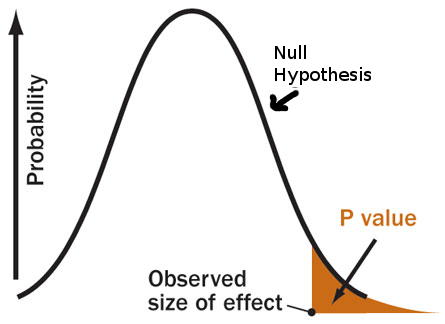
When conducting Frequentist null hypothesis significance testing, the p-value represents the probability that we would observe a result as extreme or more (this was left out of the loose definition in the podcast) than our result IF the null hypothesis were true.  So, obtaining a very small p-value implies that our result is very unlikely under the null hypothesis.  From this, our logic extends to the decision statement:

“If the data is unlikely under the null hypothesis, then either we observed a low probability event, or it must be that the null hypothesis is not true.”

It is important to note that only one of these options can be correct.  The p-value tells us something about the likelihood of the data, in a world where the null hypothesis is true.  If we choose to believe the first option, the p-value has direct meaning as per the definition above.  However, if we choose to believe the second option (which is traditionally done when p<0.05), we now believe in a world where the null hypothesis is not true.  The p-value is never a statement about the probability of hypotheses, but rather is a statement about data under hypothetical assumptions. Since the p-value is a statement about data when the null is true, it cannot be a statement about the data when the null is not true.

How does this pertain to what was said  in the episode?  The host stated that:

“…you could be 93% confident that the results didn’t happen by chance, and still not reach statistical significance.”

Referring to the case where you have observed a p-value of 0.07.  The implication is that you would have 1-p=0.93 probability that the null is not true (ie that your observations are not the result of chance alone).  From the discussion above, we can begin to see why this cannot be the case.  The p-value is a statement about your results only when the null hypothesis is true, and therefor cannot be a statement about the probability that it is false!

An example:

With our complete definition of the p-value in mind, lets look at an example. Consider a hypothetical study similar to those analyzed by the Cochrane group, in which a thousand or so individuals participated. In this hypothetical study, you observe no mean difference in mortality between the high salt and low salt groups. Such a result would lead to a p-value of 0.5, or 50%. Meaning that if there is no real effect, there is a 50% chance that you would observe a result greater than zero, however slightly. Using the incorrect logic, you would say:

“I am 50% confident that the results are not due to chance.”

Or, in other words, that there is a 50% probability that there is some adverse effect of salt. This may seem reasonable at first blush, however, consider now another hypothetical study in which you have recruited just about every adult in the population, (maybe you’re giving away iPads or something), and again you observe zero mean difference in mortality between groups. You would once again have a p-value of 0.5, and might again erroneously state that you are 50% confident that there is an effect. After some thought, however, you would conclude that the second study provided you with more confidence about whether or not there is any effect than did the first, by virtue of having measured so many people, and yet your erroneous interpretation of the p-value tells you that your confidence is the same.

The solution:

I have heard this fallacious interpretation of p-values everywhere from my undergraduate Biometry students, to highly reputable peer reviewed research publications.  Why is this error so prevalent?  It seems to me that the issue lies in the fact that what we really want to be able to say is not a statement about our results under the assumption of no effect (the p-value), but rather a statement about hypotheses given our results (which we do not get directly through the p-value).

One solution to this problem lies in a statistical concept known as power. Power is the calculation of how likely it is that you would observe a p-value below some critical value (usually the canonical 0.05), for both a given sample size and the size of the effect that you wish to detect. The smaller the size of the real effect that you wish to measure, the higher the sample size required if you want to have a high probability of finding statistical significance.

This is why it is important to distinguish, as was done in the episode, between statistical significance, and biological, or practical significance. A study may have high power, due to a large sample size, and this can lead to statistically significant results, even for very small biological effects. Alternatively the study may have low power, in which case it may not find statistically significant results, even if there is indeed some real biologically relevant effect present.

Another solution is to switch to a Bayesian perspective.  Bayesian methods allow us to make direct statements about what we are really interested in – namely, the probability that there is some effect (general hypotheses), as well as the probability of the strength of that effect (specific hypotheses).

In short:

What we really want is the probability of hypotheses given our data (written as P(H | D) ), which we can obtain by applying Bayes rule.

What we get from a p-value is the probability of observing something as extreme or more than our data, under the null hypothesis ( written as P(x>=D | Ho) ).  Isn’t that awkward? No wonder it is so commonly misrepresented.

So, my word of caution is this: We have to remember that the p-value is only a statement of the likelihood of making an observation as extreme or more than your observation, if there is, in fact, no real effect present. We must be careful not to perform the tempting, but erroneous, logical inversion of using it to represent the probability that a hypothesis is, or is not true. An easy little catch phrase to remember this is:

A lack of evidence for something is not a stack of evidence against it.

Using simulation to demonstrate theory: Hardy-Weinberg Equilibrium

One of my teaching roles is in an introductory Genetics course, where first year students are presented with a wide range of new ideas at a relatively fast pace.  It seems that often, students choose to take a memorization approach to learning the material, rather than taking the chance to think about how and why these genetic concepts actually work.  It is my conviction that, as teachers, it is our role to provide students with the opportunities to engage with the course material, and construct a solid understanding that will serve them as they proceed on to higher specialization.

When it comes to bang for my pedagogical buck, I have found that you really can’t beat the use of simulation as a platform for providing the opportunity for students to engage with theoretical concepts.  Here is an R script which I have written and used to allow students to explore how random mating in a population leads to the well known Hardy-Weinberg (HW) distribution.

For those who need a refresher, HW describes the genotype frequencies in randomly mating population. For the simple two allele case (A >> a), the frequencies are denoted by p and q; freq(A) = p; freq(a) = q; p + q = 1. If the population is in equilibrium, then freq(AA) = p2 for the AA homozygotes in the population, freq(aa) = q2 for the aa homozygotes, and freq(Aa) = 2pq for the heterozygotes.

What doesn’t usually get mentioned in introductory courses, is that the HW formula provides the expected frequencies of each genotype.  Of course, in real, finite populations, there will be variability around these values.  The seeming exactness of HW obscures the random processes at play.  To help students see how HW arises in finite populations (as opposed to the theoretical infinite populations required for the strict solution), I let them play with this simulation (R script).

Students can play around with the population size (N) and the number of generations (num_generations), to see how well the simulated populations correspond to the predicted HW.  Here is a plot of 200 simulated populations of size N=200, which are initiated out of the HW equilibrium and then randomly mated for one generation:

Feel free to try it out in your own class!

-BayesianBiologist

Teaching Bayes using something students get: Grades.

When it comes to teaching Bayesian reasoning, I am always searching for new ways to relate the process of formal belief updating to students.  One idea I had, was to use something that is no doubt on the minds of many students most of the time: their grades.

This worksheet (pdf) allows students to place prior probabilities on their grade outcomes in a course.  They can then use their observations (grades on assignments, quizzes, etc) to update their grades probability distribution. As my students use R in the lab, they can then plot their posteriors as the course progresses.  The exercise can also be used to explore the idea that any prediction/inference made in this way is always conditional on the model.

Feel free to try it out in your class!